Put Another Nickel in the Jukebox
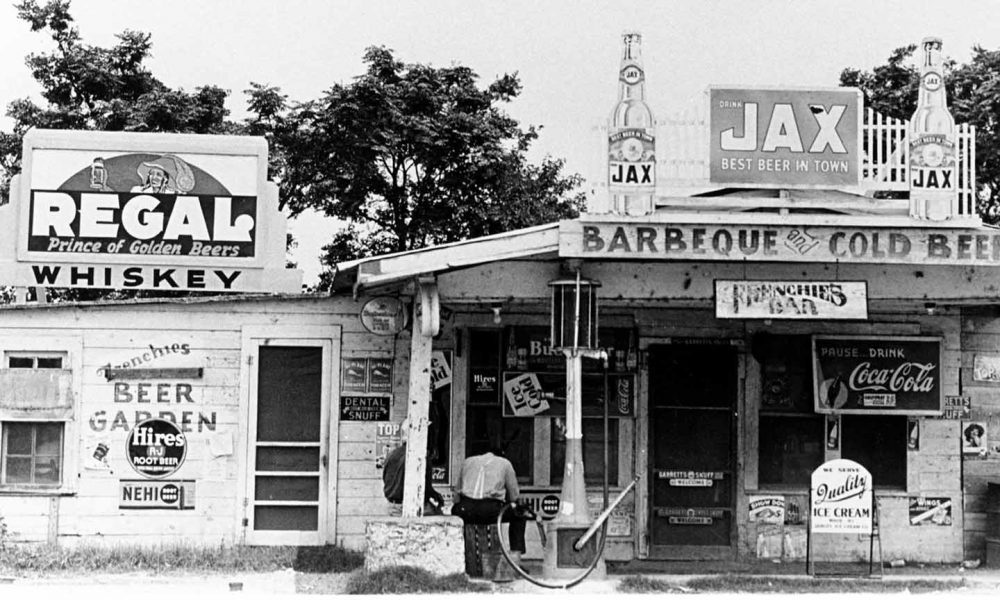
“We had these little juke joints, little taverns at that time. On a weekend there was this little place in the alley that would stay open all night. We called them Saturday night fish fries, they had two or three names; they called ‘em juke houses.” – Muddy Waters
Juke is a West African word, in one language it means wicked or disorderly and in another Congolese language it means, a building without walls. The word juke passed into popular usage with a sexual overtone among African Americans from the Southern States, it later came to describe a sort of dance. Like many derivative words, it’s almost impossible to get to the complete truth.
Generally, Juke joints were found in rural areas and it has been suggested that there is a link to the jute fields and the jute workers that frequented makeshift bars. A juke joint typically had a bar that fronted onto the street, often with a dance floor and a back room for gambling or other activities; some Juke joints doubled as a brothel. The need for music in such a place is obvious. During the 1930’s itinerant musicians, often bluesmen used the Juke Joints as their regular gigs. It was in a Juke that Robert Johnson watched Son House, while Tommy Johnson studied Charley Patton.
Robert Johnson was allegedly poisoned at this juke joint.
In 1928 Justus P. Seeburg invented one of the first jukeboxes and by the mid, to late 1930s they could be found in bars, cafes, and juke joints right across America, but particularly in working-class areas where people were less likely to own their own phonograph. In late 1938 Billboard began a new chart, which was a survey of the most popular records on Juke Boxes in America.
By 1939 there were 225,000 jukeboxes in America, which prompted James Caesar Petrillo, the President of the American Federation of Musicians to declare that records were “the number one scab”. He and his members felt that records and record companies were taking work away from musicians. Largely because of the jukebox the AFM called a strike of its members in 1942; their motive was to persuade record companies to create a trust fund to compensate musicians who might lose live work as a result of records played on jukeboxes and the radio. The strike ended in 1944 and the spread of the jukebox and the availability of an increasing number of phonographs was what the musicians strike had hoped to address. In reality, the strike, along with the war, helped bring on the demise of the big band. The singer was the star; the traditional bandleader would never again be preeminent.
Black music of the late 1940s and early 1950s was what was most commonly found on jukeboxes. It was what evolved into rock ‘n’ roll and the beautiful looking jukeboxes became pivotal in spreading the gospel according to rock ‘n’ roll.
Films like American Graffiti fuelled the mythical status of the Juke Box, as did the teenagers who hung out in the diner in the hit TV show Happy Days. Standing around the record machine, deciding what to play, is an enduring image of a bygone era of unit uninterrupted happiness. Certain records just sound better on a jukebox, but as most of us don’t have one to hand we’ve put together what we think is the start of the Ultimate Juke Box playlist. Let us know what you think we should add.
 UK English